

PALM BEACH GARDENS | Across the United States, many dioceses have reported a surge in people seeking the Catholic faith. Whatever you call it — an uptick or revival — it’s good news for catechists and church leaders. It means that more people are taking their salvation seriously.
In the Diocese of Palm Beach, the increase in adults desiring full communion with the church is seen in higher numbers of catechumens (those never baptized) and candidates (those baptized in another Christian faith but seeking the Catholic sacraments of Eucharist and confirmation).
In 2024, there were 219 catechumens and 460 candidates (679 total), and in 2025, 285 and 558 (843), respectively. This year, at the Rite of Election and Calling of Candidates to Continuing Conversion on Feb. 21-22, there were 342 catechumens and 655 candidates (997). That’s a 24.15% difference between 2024 and 2025, and a 46.83% increase from 2024 to 2026. To break it down even further, over those three years, there were 56.16% more catechumens and 42.39% more candidates.
So, what does it mean? The Florida Catholic asked Cathy Loh, director of the diocesan Office of Marriage, Family Life, Faith Formation, and Youth and Young Adult Ministry, and Liliana Soto-Cabrera, diocesan coordinator of the Order of Christian Initiation of Adults, what they think of the increases. The big question is: Why is it happening?
Drawn to the truth
“I think they realize the world isn’t giving them what they thought,” Loh said. Young adults especially are finding out there is more to their existence than work and play. A new organization called Touch Grass, she said, encourages Gen Z to “get outside and touch reality again. They actually have chapters all around the country, and particularly at colleges, and they’ll organize events of things that we would have just done naturally,” like having a snowball fight or going to a park.
“The world they’re living in is not the real, physical world that we know, and they realize that they’re getting sicker, physically actually, and emotionally and everything else. The movement is to pluck them out of that. And I think if they do that, they start to see reality, and they realize that there are things missing in their lives,” Loh said.
With the popularity of Catholic evangelizers (Father Mike Schmitz, Bishop Robert Barron, Dr. Scott Hahn), and apps and websites that focus on faith, such as Hallow, Formed and Laudate, young people have solidly Catholic content at their fingertips, meeting them where they are. Many of the “unchurched” are being drawn to the truth, structure and beauty of the faith, Loh and Soto-Cabrera said.
Even though the Easter Vigil has passed this year, they said there is a noticeable increase in the number of people who continue to inquire about the faith and what is involved in becoming initiated into the Catholic Church.
Strong friendships
Greg Pratt, director of adult faith formation at the Cathedral of St. Ignatius Loyola, said his short answer to the question of why people are moving toward the Catholic Church is “when the world goes crazy, people turn to God.”
“People are just hungry for truth. They are looking for anybody, any institution, who’s willing to stand up for objective truth, objective morality, objective ethics, and say there’s a basis for it — which is God, of course — and to just stand on that. It’s not somebody’s opinion this or somebody’s opinion that, which can shift. They just want something solid,” he said.
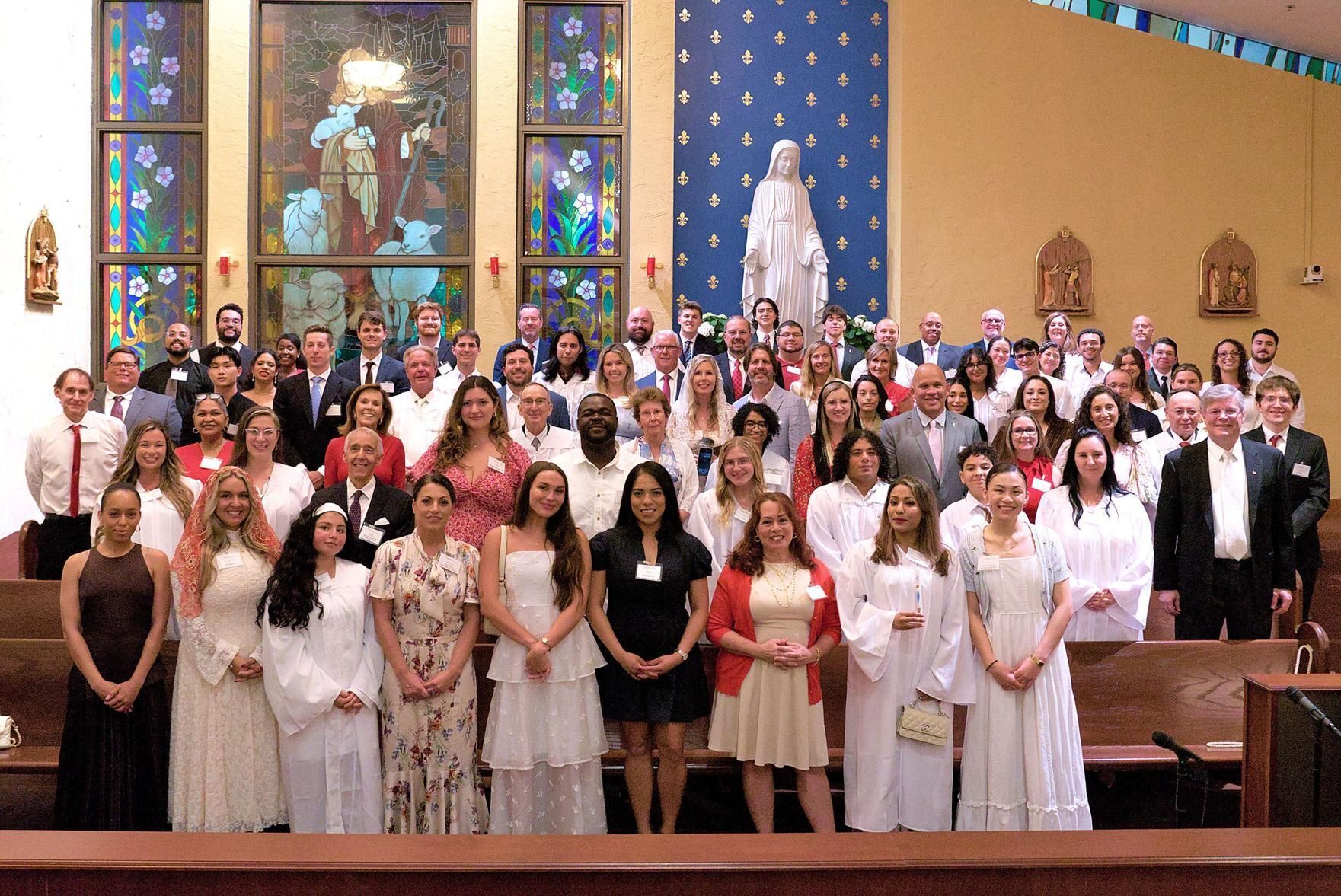
Two years ago, 28 people entered into full communion with the church at the Easter Vigil. Last year, the number jumped to nearly 50, and this year there were 77. The actual number who went through the program in 2025-26 was more than 80, Pratt said, but some were to be received into the faith outside the Easter Vigil.
About 45% of this year’s OCIA class at St. Ignatius are less than age 30, Pratt said, with more than two-thirds under 40. Several years ago, when he was in charge of the program at Ascension Parish in Boca Raton, almost all were enrolled because they desired to get married in the church. Now only a few were in OCIA for that reason.
He has seen strong friendships develop among OCIA candidates drawn toward each other around their mutual search for God. “The common thread here is that we are trying to live a good life and find out what God wants of us, and to move in that direction, imperfect as we all are, but to move in that direction,” Pratt said. “We all have that same desire, which is an extremely admirable goal, and when we recognize that in each other, it just naturally creates a friendship, even if we’ve got completely different backgrounds elsewhere.”
Since it’s now after the 2026 Easter Vigil, the OCIA program shifts to a phase called mystagogy, a period of education and formation for the newly initiated in which they reflect on how they will serve Christ and can further the church’s mission. Focusing on the Scriptures, sacraments and church teaching, this lasts until about Pentecost.
“During this time, we’re building a bit more camaraderie within the group,” he said. “Plus, I’ll be offering another Bible study for the whole parish soon. As new Catholics, the OCIA group will be invited to be part of that, and therefore begin making connections to the overall parish family.”
“Be ready to receive them”
Building parish leaders and helping them integrate new members is a priority for Loh and Soto-Cabrera. If more people are looking to become members of the Catholic Church, the parishes need to be prepared to welcome and form them, they said.
“We really have got to be dynamic and understand that they’re being called by the Spirit to come into the church,” Loh said. “It’s a revival. We have to be ready to receive them. So, that’s where we have to work really hard,” Soto-Cabrera added.
It’s vital for Catholics in the pews to realize that their conversion is ongoing, the same as former Protestants who go through the Rite of Continuing Conversion, she said. “We should all be continuing. It’s not ‘Once saved, always saved.’”
Loh added that it’s an exciting time. “People are responding. And now we need to be ready to respond to them in turn to help them grow deeper in their faith and get connected. Yes, they’re adults and they need to take responsibility for their own growth, but I think it’s our responsibility as a church to continue to support and encourage them in the process.”
To learn about ministry in the Diocese of Palm Beach, visit www.diocesepb.org and connect through Facebook, Instagram and X. Connect with Cathy Loh at cloh@diocesepb.org, and with Liliana Soto-Cabrera at lsotocabrera@diocesepb.org, or Greg Pratt at the cathedral at gpratt@cathedralpb.com.
