

Ordained to be a Minister of Joy
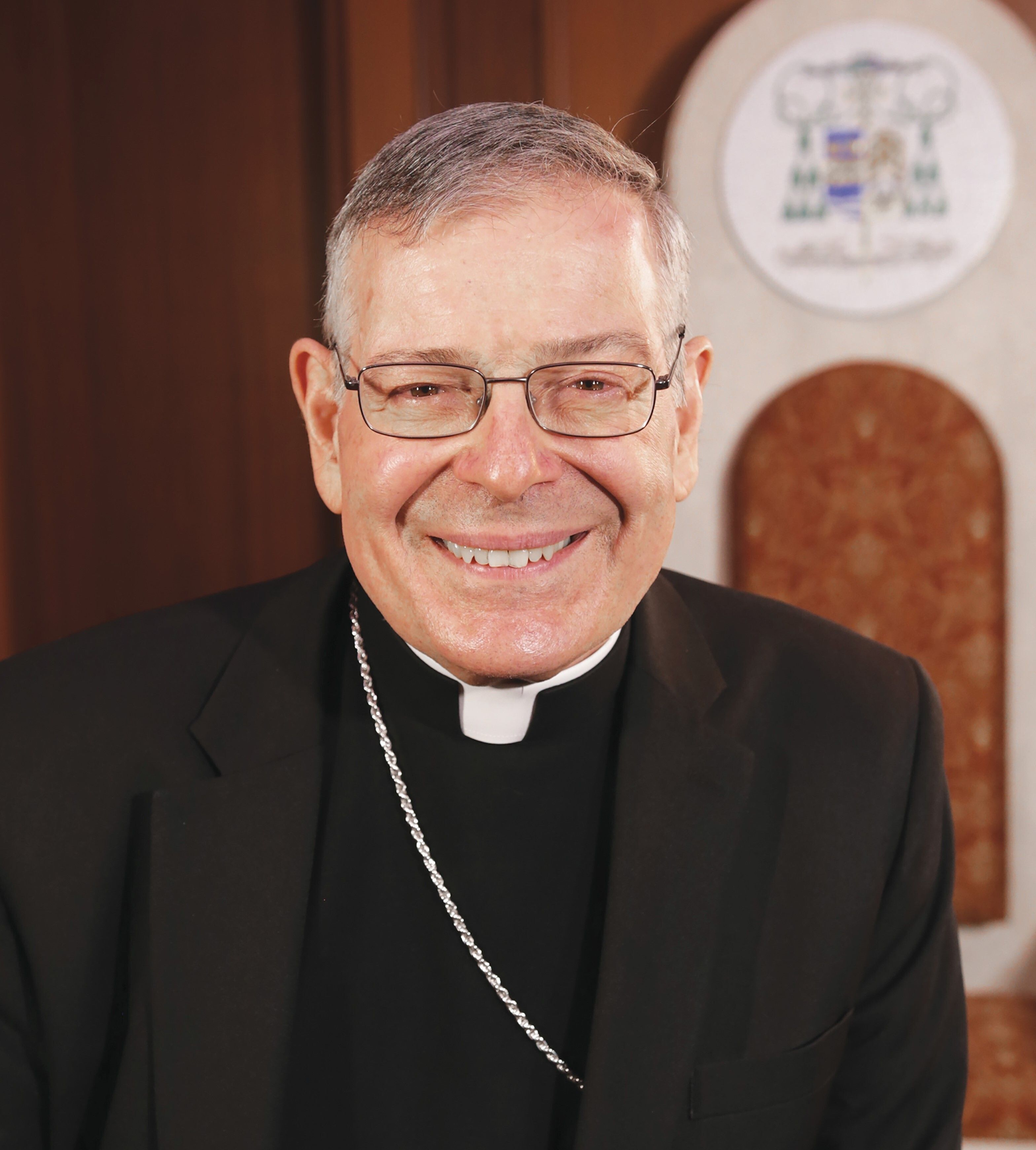
Editor’s note: The following is Bishop Barbarito’s homily from the Jan. 31 ordination of Father Jedidiah Preble.
Almost 40 years ago, Cardinal Joseph Ratzinger, who many years later was elected as Pope Benedict XVI, put together a number of his homilies and talks given over the years to priests and seminarians on the meaning of priesthood. One was a homily for a first Mass. He entitled his small book Ministers of Your Joy. In its forward, he wrote, “The theme that runs through all these reflections is the joy that comes from the Gospel. I hope, therefore, that this slim volume may help to serve this joy and may thereby answer the utmost meaning of the priest’s tasks.”
As we gather on this day of joy to ordain our brother, Deacon Alpha Jorge Jedidiah Preble, as a priest of the Diocese of Palm Beach, it is essential to reflect upon the ministry he will undertake as a priest in becoming a minister of joy. This is especially appropriate on this Feast Day of St. John Bosco, popularly known as Don Bosco, who was a minister of joy par excellence. My brother, Deacon Jedidiah, St. John Bosco is an exceptional saintly mentor to have before you on the day of your ordination, as well as on all of the days of your priesthood. He gives us, as priests, a marvelous example of what it means to be a priest and the encouragement to persevere in our priestly lives in a joyful manner.
He is a modern-day saint born in 1815 in Piedmont, Italy. He came from a peasant family, lived a very poor life, and, with difficulty, was ordained a priest, which he wanted to be from his earliest days. He was able to touch people of all walks of life, most especially the young, to whom he devoted his ministry. He founded the Salesian order, which devoted itself to the education of poor and neglected young people, in accord with his revolutionary educational model. He had great devotion to the kindness and gentleness of St. Francis de Sales, who lived almost 300 years before him. Don Bosco founded his congregation, which he named the Order of St. Francis de Sales, the Salesians, in honor of him. St. John Bosco performed many miracles during his lifetime and had a number of dreams and prophecies which came to pass. He truly was a revolutionary in terms of the politics of his time in the area of Turin, where many lived in poverty and difficult conditions. He even encountered difficulty with the Church.
Pope Francis had great devotion to St. John Bosco, about whom he spoke and wrote frequently. He was influenced by the Salesians from his early education and used to uphold Don Bosco as a model of priesthood, particularly in regard to his going to the peripheries to serve the poor young people of his time. The pope especially emphasized the joy which was part of Don Bosco’s life and ministry. He referred to St. John Bosco as the “master of joy” and the “teacher of joy.” The Salesians put together a collection of essays on Pope Francis’ exhortation Evangelii Gaudiúm entitled The Joy of the Gospel with Don Bosco. Pope Francis wrote a preface for this work in which he told the Salesians that they were fortunate to have a founder who had a face that reflected the joy of Easter Sunday rather than the sorrow of Good Friday. The pope described St. John Bosco as one who “was always joyful, welcoming, despite thousands of labors and difficulties that beseeched him every day.”
Don Bosco was a priest, intensely devoted to the Eucharist and to his daily celebration of Mass. He was known to draw large crowds to his Masses as he celebrated the Eucharist with such devotion. My brother, Jedidiah, the Eucharist will be the center of your priestly life from this day forward as you celebrate your first Eucharist at this altar after your ordination today. All that you do in your priesthood will flow from and to the Eucharist you celebrate each day. The Eucharist will bring you great joy in your ministry the closer you are part of the action of Christ which you will celebrate. The joy of ministry goes hand in hand with the celebration of the Eucharist.
St. John Bosco celebrated a number of Masses during the first week after his ordination to the priesthood in places that had special meaning to him. After that week, when he was at home with his mother, he recounted, “When we were alone that day, my mother said to me these memorable words: ‘You are now a priest, and you celebrate Mass. You are therefore closer to Jesus Christ. But remember that to begin to say Mass is to begin to suffer. You will not become aware of this immediately but little by little you will realize that your mother was right.’” These were insightful words from Don Bosco’s mother, reminding him of the unique union that he had with the Lord in the Eucharist and how he would participate in an intimate manner in the Lord’s Passion, which leads to life and leads to joy. Don Bosco was always able to carry the joyful face of Easter Sunday because he participated in the Eucharist through the suffering of Christ and His Resurrection. Don Bosco’s mother words to her son reflect those of the Lord today in the first reading from the Book of Jeremiah: “Do not say, ‘I am too young.’ To whomever I send you, you shall go; wherever I command you, you shall speak. Do not be afraid of them, for I am with you to deliver you” (1:7-8).
One of the aspects of St. John Bosco’s priesthood which is significant for the ordination to priesthood which we celebrate today is the promises which he made on his ordination. In addition to the promises that are part of priestly commitment, Don Bosco made eight additional promises which he wrote down while on his retreat before priesthood. These were not simple promises but very difficult ones which he adhered to, such as a limited number of hours of sleep, restriction of food and strict discipline over himself. He meticulously followed these promises in the spirit of the joy and generosity which were the hallmark of his priesthood. One of the promises he made was “May the charity and gentleness of St. Francis de Sales illuminate every step I take.” He lived this gentleness in his life in very practical ways. He often quoted the famous maxim of St. Francis de Sales, “Do not forget the importance of gentleness in our actions; win over the hearts of the young by means of love; remember that saying of Francis de Sales, ‘More flies are caught with a cup of honey that with a barrel of vinegar!’”
It is good to remind ourselves, as priests, that making small promises regarding gestures of understanding and kindness, especially to those who offend us, intentionally or not, support, in a concrete fashion, the promise we make to imitate the Lord in all things. As St. John Bosco exhorts his priests today in the Office of Readings, “My sons, in my long experience very often, I had to be convinced of this great truth. It is easier to become angry than to restrain oneself … yes, indeed, it is more fitting to be persistent in punishing our own impatience and pride than to correct … we must be firm but kind, and be patient …”
Pope Francis emphasized that Don Bosco had always before him three loves in his priesthood: his love of the Eucharist, his love of the Blessed Mother and his love of the Church. My brother, Deacon Jedidiah, as you are ordained today these three loves are essential to the lasting joy of your ministry and your spreading that joy in the lives of others. Pope Francis also emphasized that St. John Bosco did not see himself as a functionary, but as one who walks with others. Don Bosco had the ability to see with human eyes and with the eyes of God. Such is the key to wisdom and joy.
We join with you today, Jedidiah, in great joy as you become a priest for the Diocese of Palm Beach and as you join your brother priests in carrying out the ministry of Christ. As you are ordained on the Feast of St. John Bosco, may his example and joy be before you in a particular way, and he will always lead you to the Lord’s joy, which, in the words of Cardinal Ratzinger, “may thereby answer the utmost meaning of the priest’s tasks.” I conclude with the words of Pope Francis: “Today, let us ask the Lord for the intercession of Don Bosco, for the grace for our priests to be joyful: joyful so that they may have the true sense of looking at things regarding pastoral ministry, the people of God, with human eyes and with the eyes of God.”
May the Lord who now begins this good work in you continue to bring it to fulfillment through the joy of His priesthood.
Most Reverend Gerald M. Barbarito
