

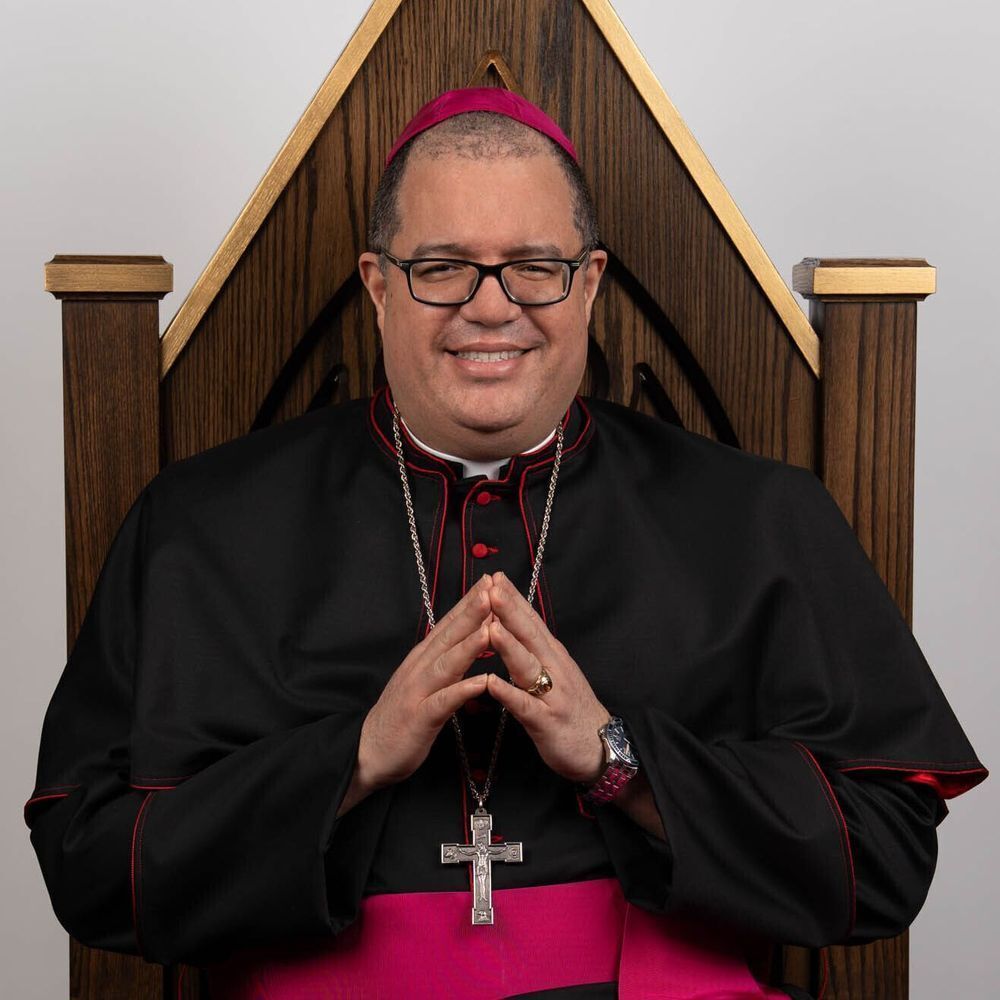
Since my arrival to my beloved Diocese of Palm Beach, I have made no secret about the fact that I do have a favorite saint. Today, on the occasion of her feast day, I am pleased to share some reflections about her extraordinary life and legacy.
Last Saturday, May 30, marked the 595th anniversary of the death of St. Joan of Arc, who was burned at the stake on that day in 1431 in Rouen, France. Her death was the result of a trial marred by numerous injustices, abuses and political compromises, all designed to advance the interests of England, which sought to control France during the latter stages of the so-called Hundred Years’ War.
The legitimate heir to the French throne was the Dauphin Charles de Valois, son of King Charles VI, who had died in 1422. By 1429, however, Charles had not yet been crowned king of France because of the English occupation of large portions of the kingdom and the alliance between England and the Duke of Burgundy.
Joan was born in Domrémy, a small village in northeastern France. At the age of 12, she began to experience visions and hear voices, which she later identified as those of St. Michael the Archangel, St. Catherine of Alexandria and St. Margaret of Antioch. She believed that God had entrusted her with a mission: to assist the Dauphin in securing his rightful crown and becoming King Charles VII, thereby helping to restore the unity of France under the banner of the Christian faith.
Through her remarkable courage, perseverance and unwavering trust in God, Joan — still only a teenager — succeeded in convincing the Dauphin to allow her to accompany and inspire French military efforts aimed at liberating territories occupied by the English. These objectives were achieved in dramatic fashion, most notably through the lifting of the Siege of Orléans and the subsequent campaign that opened the way to Reims. There, following centuries of French tradition, Charles VII was solemnly crowned king of France. Throughout the ceremony, Joan stood near the altar of the great cathedral, holding the banner that had accompanied her throughout her mission.
In 1430, Joan was captured by forces allied with the English and sold to them. She was subsequently subjected to an ecclesiastical trial on charges of heresy and for wearing male attire. The proceedings were presided over by Bishop Pierre Cauchon of Beauvais, with the participation of theologians and scholars associated with the University of Paris. The trial was deeply flawed and heavily influenced by political considerations. Joan was ultimately condemned, burned at the stake, and her ashes were cast into the Seine River. Such so-called trial, through which a young girl was repeatedly the subject of cruel forms of violence and violation of her dignity and rights, remains a shameful, repugnant episode in the history of Canon Law and of the Church.
Twenty-five years later, a new ecclesiastical tribunal, acting under papal authority, reviewed the case and declared the original trial null and void, completely overturning the verdict. Nearly five centuries after her tragic and unjust death, on May 16, 1920, Pope Benedict XV canonized Joan of Arc as a saint of the Catholic Church.
Virgin, mystic, patriot and soldier, St. Joan of Arc remains one of the most extraordinary figures in Christian history. She is honored as the patron saint of France and of military personnel, and her life continues to inspire countless believers with its example of courage, fidelity and complete trust in the will of God.
Here in the Diocese of Palm Beach, we hold St. Joan of Arc in particular affection and esteem. One of our largest and most vibrant parish communities bears her name: the Church of St. Joan of Arc in Boca Raton. This flourishing parish stands as a living tribute to that courageous young saint who, more than five centuries ago, demonstrated to the world that a young person who takes God seriously can truly transform circumstances, influence the course of history and even change the world.
In an age often marked by uncertainty and skepticism, St. Joan continues to remind us that faith, courage and fidelity to God are not matters of age but of conviction and holiness of life.
I especially invite my dear friends, the young people, to look at St. Joan of Arc as a role model: like her, you can also change your country and change the world, if you strongly believe in the power of God present in your heart and act upon it. Be stubborn and unapologetic about it. Do what she did: keep listening to God’s voice in you, to God’s call to you … and you will achieve wonders.
Bishop Manuel welcomes comments and reflections from readers: bishopofpalmbeach@diocesepb.org
