

The hands came through the iron bars, one after another. Men condemned to die reached for ours, asked for a blessing and received the Body of Christ. Then, on Florida’s death row, we sang “Amazing Grace” together.
On Friday, Nov. 13, I led a pilgrimage of faithful from the Diocese of Palm Beach to Union Correctional Institution in Raiford, where many of the men sentenced to death in Florida wait. It is a heartbreaking place. Our faith does not allow us to look away from it.
No state is killing more of its prisoners. In 2024, Florida carried out one execution. In 2025, it carried out 19 — more than double its previous record, and 40 percent of all executions in the United States that year. This year, the pace has quickened. By mid-November, Florida had carried out 19 of the nation’s 37 executions, more than every other state combined, and a 20th, which would set a new state record, was scheduled for the following week. A state that is home to about one in 15 Americans now accounts for roughly half of the executions in the country.
The machinery moves fast. Executions now come roughly every month. To make it even more sinister, on July 28, Florida put two men to death on the same day, something no state had done since 2017. One of them was 80 years old.
The night before our visit, we began at an altar. On Nov. 12, I celebrated Mass with Bishop Erik Pohlmeier of St. Augustine at the National Shrine of Our Lady of La Leche, the first Marian shrine in what is now the United States. The image venerated there is simple: a mother nursing her child. In my homily, I reminded the pilgrims that every man on Florida’s death row was once a baby at his mother’s breast — and so was every victim.
We had not come to that shrine by accident. Both death row and the execution chamber lie within the Diocese of St. Augustine, and from 2011 to 2022 its shepherd was Bishop Felipe Estévez, now bishop emeritus. He treated the men on death row as his own flock, visiting them in person at least twice a year, and he kept going after he retired. As the executions accelerated, he stood in prayer outside Florida State Prison while men were put to death inside, and he called the death penalty “a failure of mercy and moral imagination.”
In a 2020 pastoral letter, Bishop Estévez consecrated the work of ending the death penalty in Florida to Our Lady of La Leche, at that very shrine. At the same altar, with Bishop Pohlmeier, we renewed his consecration.
Afterward, Bishop Pohlmeier led us by lantern light across the grounds where the Catholic faith first took root in this land, past the site where the first parish Mass in what is now the United States was offered in 1565. We walked in darkness, small lights in our hands.
The next morning, we carried that light into a very different place. Welcomed by the senior chaplain, Joseph Keys, and accompanied by Mr. Paul of the Diocese of St. Augustine’s prison ministry, we came to the cells. The bars stood between us, but they could not stop an encounter of hearts. Some of the men shared fragments of their stories. Our voices and theirs rose together in “Holy, Holy, Holy! Lord God Almighty!” Behind every prison door, beyond every sentence and every human failure, there remains a person made in the image and likeness of God — a brother whose dignity can never be erased.
Two hours. That is all the time these men may spend in the sunlight each week. The rest of the time they are confined to their cells, with no air conditioning, their meals brought to them. Some are more than 90 years old.
About 230 men and one woman are under sentence of death in Florida. For each of them, the end begins with a signature: the governor’s death warrant. Days before the execution, the condemned is taken from his cell to a facility next door, to wait.
Florida stands apart in other ways as well. It is one of only two states that allow a jury to recommend death without a unanimous vote, and its threshold is the lowest in the nation: eight jurors out of 12. A person can be sent to death row here even when a third of the jury votes for life. Florida has also freed more innocent people from death row than any other state — 30 since 1973, most of them condemned by divided juries or by judges who overrode a jury’s call for mercy. And no one on Florida’s death row has been granted clemency in more than four decades.
The Church teaches that the death penalty is inadmissible because it attacks the inviolability and dignity of the human person. On July 27, the day before Florida’s double execution, we, the Catholic bishops of Florida, issued a pastoral letter on the death penalty. We reminded Catholics that the Church teaches against capital punishment wherever bloodless means are enough to punish offenders and protect the public, as they are in our state, and we warned that it feeds “a culture of death.” The letter is available in English and Spanish on our diocesan website at www.diocesepb.org/news/history/death-penalty.html. To say all this is not to minimize the suffering of victims and their families, or the gravity of the crimes. It is to proclaim that no one is ever beyond the reach of God’s mercy.
I am grateful to Catholic Charities of the Diocese of Palm Beach — Ellen Wayne, Deanna Herbst-Hoosac, Donna Pearson, Sydney Avila and Deacon Gregory Quinn — who made this pilgrimage of mercy possible. Beginning this year, our diocese will make it every year.
We went to bring a little consolation to men behind prison walls. We came back changed. May we never forget the words of our Lord:
“I was in prison and you visited me” (Matthew 25:36).
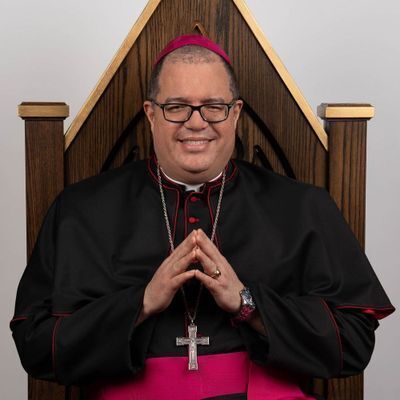
Bishop Manuel de Jesús Rodríguez
