

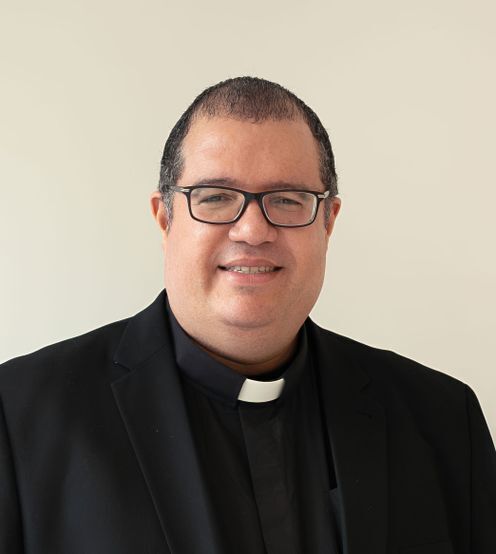
Reverend Manuel de Jesús Rodríguez
Welcome to Most Reverend Manuel de Jesús Rodríguez, J.C.D.
Appointed Sixth Bishop of the Diocese of Palm Beach
Pope Leo XIV has appointed Father Manuel de Jesús Rodríguez, currently pastor of Our Lady of Sorrows Parish, Corona (Queens), New York, as the sixth Bishop of Palm Beach. Most Reverend Manuel de Jesús Rodríguez succeeds Bishop Gerald M. Barbarito, who has served the diocese since 2003.
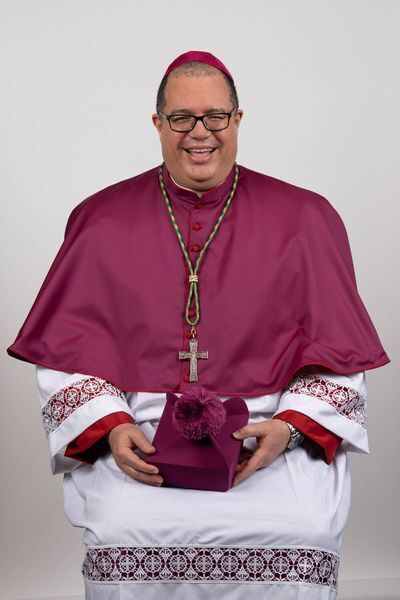
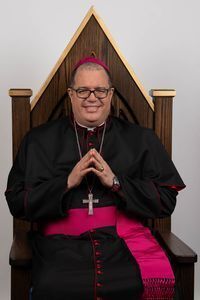
Official Photos
News
Pope Leo XIV has appointed Father Manuel de Jesús Rodríguez, currently pastor of Our Lady of Sorrows Parish, Corona (Queens), New York, as the sixth Bishop of Palm Beach. The bishop-elect succeeds Bishop Gerald M. Barbarito, who has served the diocese since 2003.
Diocesan Decree 014-2026, of Aug. 29, 2026, announces the appointment of Anthuanette Hidalgo as the new victim assistance coordinator for the Diocese of Palm Beach and establishes the policies and procedures that will govern her work.
Bishop Manuel de Jesús Rodríguez has issued Decree No. 013 establishing new diocesan offices with accompanying leadership appointments and clergy assignments.
Bishop Manuel de Jesús Rodríguez has promulgated Particular Law No. I-2026 consisting of diocesan regulations, policies and procedures related to the safeguarding of the people of God.
Biography
A native of the Dominican Republic, Bishop-Elect Rodríguez was ordained to the priesthood July 3, 2004, in Santo Domingo, and became affiliated with (incardinated into) the Diocese of Brooklyn, New York, on June 29, 2012. He is a canon lawyer with extensive experience in penal canon law and pastoral leadership. Besides his parish responsibilities in Queens, he serves in senior juridical roles in the Brooklyn Diocese, including promoter of justice and delegate of the diocesan bishop for penal cases. Bishop-Elect Rodríguez is fluent in four languages (English, Spanish, Italian and French).
Pope Leo XIV has appointed Father Manuel de Jesús Rodríguez, currently pastor of Our Lady of Sorrows Parish, Corona (Queens), New York, as the sixth Bishop of Palm Beach. The bishop-elect succeeds Bishop Gerald M. Barbarito, who has served the diocese since 2003.
Curriculum Vitae
Click here to download the Curriculum Vitae
Click here to download the Curriculum Vitae in Spanish
Catholic priest and canon lawyer with extensive experience in penal canon law and pastoral leadership. Currently serving in senior juridical roles within the Diocese of Brooklyn, including Promoter of Justice and Delegate of the Diocesan Bishop for Penal Cases. Combines advanced canonical scholarship, international academic formation, and long-standing parish leadership.
ORDINATION & INCARDINATION
- Diaconal Ordination: June 29, 2003 – Rome, Italy
- Presbyteral Ordination: July 3, 2004 – Santo Domingo, Dominican Republic
- Incardination: Diocese of Brooklyn – June 29, 2012
EDUCATION
- Doctor of Canon Law (J.C.D.), University of Navarra, Pamplona, Spain, 2024
- Licentiate in Canon Law (J.C.L.), The Catholic University of America, Washington, DC, 2016
- M.S. in Education, Universidad INTEC, Santo Domingo, Dominican Republic, 2008
- M.S. in Administration of Educational Centers, Universidad INTEC, Santo Domingo, Dominican Republic, 2005
- B.A. in Theology, Pontificia Università Salesiana, Rome, Italy, 2003
- B.A. in Law, Pontificia Universidad Católica Madre y Maestra, Dominican Republic, 1998
- B.A. in Education (Literature Specialization), Universidad Católica Santo Domingo, Dominican Republic, 1997
- B.A. in Philosophy, Pontificia Universidad Católica Madre y Maestra, Dominican Republic, 1996
DIOCESAN & CANONICAL APPOINTMENTS
- Promoter of Justice, Diocese of Brooklyn (2025–present)
- Delegate of the Diocesan Bishop for Penal Cases, Diocese of Brooklyn (2025–present)
- Defender of the Bond, Diocese of Brooklyn (2017–present)
- Priest Instructor for Cases of Removal from the Clerical State, Diocese of Brooklyn (2016–present)
PASTORAL LEADERSHIP
- Pastor, Our Lady of Sorrows Parish, Corona (Queens), NY (2020–present)
- Pastor, Presentation of the Blessed Virgin Mary Parish, Jamaica (Queens), NY (2014–2020)
- Pastor, Saints Peter and Paul Parish, Williamsburg (Brooklyn), NY (2011–2014)
- Parochial Vicar, Saint Michael Parish, Sunset Park (Brooklyn), NY (2009–2011)
ACADEMIC & FORMATION EXPERIENCE
- Theology and Canon Law Instructor, Holy Spirit Institute, Diocese of Brooklyn (2009–2020)
- Professor of Philosophy and Professional Ethics, Pontificia Universidad Católica Madre y Maestra (1996–1998; 2004–2009)
LANGUAGES
Spanish (native) · English (fluent) · Italian (fluent) · French (fluent)
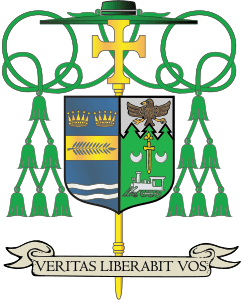
Blazon and explanation of the armorial bearings of the Most Rev. Manuel de Jesús Rodríguez, Bishop of Palm Beach, Florida
Blazon
Arms impaled. Dexter: Azure, on a fess Or between in chief two celestial crowns Or and in base two barrulets wavy Argent, a palm branch Vert (Palm Beach). Sinister: Vert between two crescents Argent a sword, point downward with the pommel in the shape of a fleur-de-lis Or above in base an antique locomotive Argent; on a chief per sapiné Argent a cigua palmera rising Proper (Rodríguez). The shield is ensigned with an episcopal cross Or and a bishop’s galero with cords and 12 tassels flanking the shield disposed in three rows of one, two and three all Vert. On a scroll below the shield is the motto, “Veritas Liberavit Vos.”
Explanation
The armorial bearings of Bishop Manuel de Jesús Rodríguez impale the coat of arms of his episcopal see with his personal coat of arms. These evoke his heritage as well as his ministry. The coat of arms is composed of a shield with its charges (symbols), a motto and the external ornamentation. The shield is described (blazoned) in terms that are archaic to our modern language, and this description is presented as if given by the bearer with the shield being worn on the arm. Thus, where it applies, the terms dexter (right) and sinister (left) are reversed as the device is viewed from the front.
It is customary in heraldry that the arms of a diocesan bishop, or ordinary, are joined side by side on the same shield with the arms of his see. In this case, these are the arms of the Diocese of Palm Beach. Such marshaling is called impalement and employs the same method used when joining the coats of arms of two people who are married. In this way, the coat of arms, like the episcopal ring, is symbolic of the bishop being “married” to his diocese.
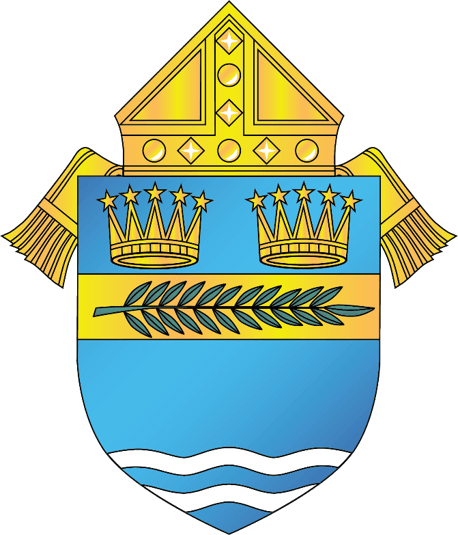
The arms of the Diocese of Palm Beach are composed of a blue field on which are placed two small wavy silver (white) bars at the bottom of the shield that signify the waters of the Atlantic Ocean, which dominates the geography of the region. In the center of the shield is a gold (yellow) bar, called a “fess,” on which is seen a green palm branch. These symbols play on the name of the see city by placing a palm branch on the golden sands of a beach, producing a symbol for Palm Beach. Above the fess are two gold (yellow) crowns topped with stars to honor the Blessed Virgin Mary in her titles of “Queen of Heaven” and “Star of the Sea.”
Bishop Rodríguez’s personal coat of arms is now assumed by him as he becomes a bishop. The main part of the field is green and upper part of it terminates in a division line in the shape of a line of fire trees suggesting a forest. This is to honor St. John Bosco, founder of the Salesian order to which the bishop originally belonged before becoming a priest in Brooklyn. The name “Bosco” means woods or forest in Italian, and the trees are used also on the coat of arms of the Salesians. In addition, the trees represent the oaks and pines abundant in the United States. Finally, trees like these also appear in the coat of arms of Bishop Gerald M. Barbarito to symbolize the same saint, Don Bosco. So, by repeating the image here, Bishop Rodríguez also honors his episcopal predecessor, who was also a priest of Brooklyn before coming to Palm Beach as its bishop.
In the center of the field is a gold (yellow) sword, a symbol of St. Michael the Archangel, the pommel of which is shaped like a fleur-de-lis as an allusion to St. Joan of Arc. The fleur-de-lis is used as a symbol in heraldry for France, and the stylized lily is also in the coat of arms of St. Joan, the “maid of Orleans.” On either side of the sword are two silver (white) crescents. These represent several things. The crescent is used in heraldry as a symbol of Our Lady under the title of the Immaculate Conception, so the crescent itself is a symbol of Mary in heraldry. In addition, the Immaculate Conception is the patroness of both the United States and the Diocese of Brooklyn. So, the two crescents honor the bishop’s adopted country and the diocese he served as a priest.
At the bottom of the shield is a stylized depiction of an antique locomotive. This is a symbol of Moca, the bishop’s hometown in the Dominican Republic. In addition, it also serves as a symbol of migrants, a special group of people to which the bishop himself belongs and who the church is always called to accompany. On the upper third of the shield, called a “chief,” we see a cigua palmera (palmchat), the national bird of the Dominican Republic, colored as it would appear in nature. By using this symbol, the bishop honors his native land.
The external ornaments include a gold episcopal cross placed vertically behind the shield. This is often mistaken for a processional cross like the one used in liturgical processions. However, like other heraldic ornaments, the episcopal cross has its origins in something that is no longer actually used. At one time, all bishops had, in addition to the processional cross at the head of the procession, another cross carried directly in front of them by a cleric. This other cross was a sign of the office of bishop. While no longer actually used, it has remained a symbol of the episcopal office in heraldry.
Similarly, the broad-brimmed green galero was, at one time, worn by bishops in outdoor processions and cavalcades. No longer used, it remains a heraldic symbol of the office of bishop and takes the place of the helmet, mantling and crest that would appear in the coat of arms of a layman. In Catholic heraldry, the color and number of tassels on the galero indicates the rank of the bearer. The single-barred episcopal cross and the green galero with 12 tassels signifies the coat of arms of a bishop according to the instruction of the Holy See, “Ut Sive,” issued in 1969.
The motto chosen by Bishop Rodríguez appears on a scroll below the shield. “Veritas Liberavit Vos,” which translates to “The truth will set you free,” is taken from Jn 8:32.
The coat of arms of Bishop Rodríguez was designed, emblazoned and marshaled to the arms of the see of Palm Beach by Father Guy Selvester, a priest of the Diocese of Metuchen, New Jersey. Father Selvester is a fellow of the American College of Heraldry and a fellow of the American Heraldry Society. The coat of arms was also digitally modified by Jacqueline Nadel of the Diocese of Palm Beach.
